Smell
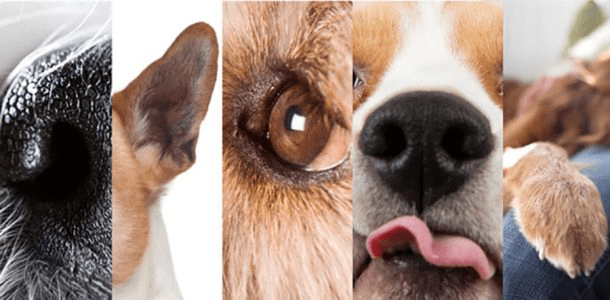
The most prominent and distinguishing sense in a dog is its sense of smell. A dog’s smell perception is a hundred thousand times stronger than ours. Dogs are estimated to have two billion olfactory sensors, a vast difference from the humans’ forty million.
Hearing
Dogs have excellent hearing. They can pick up noises four times farther away than what humans can hear. Additionally, their ears are better built to capture more sound waves that are accessible. A dog’s ears can move in all directions because of its muscles. Additionally, they may move each ear separately to take in additional information.
Touch
The way different dogs react to touch varies greatly. While some dogs enjoy a hard scratch, others enjoy a gentle pat. For a successful reaction to a cue, it is simple to praise dogs who enjoy having their chest or ears handled. Many dogs dislike having their paws stroked.
Sight
The field of sight of the eyes does not intersect as much in dogs as in humans. The area in focus is minor than humans’, though dogs have a broader vision angle than humans. Dogs can thus see farther around them, but sometimes they cannot make sense of what they see.
Dogs have excellent movement perception. They react well to instruction through hand gestures. Older studies stated that dogs have colourblindness; however, later research has shown this is untrue.
They frequently have more robust night vision than we do. Dogs’ eyes also include a second reflecting layer that reflects light into the eye’s receptor cells. This attribute improves their night vision and makes their eyes appear to shine in low-light situations.
Taste
Taste and smell are connected, much like in people. Each dog has a unique set of tastes. Take a proactive approach to your pet’s health with regular health and wellness checks at your animal hospital Bellaire, TX.
 Helalth Care